

TL:DR;
The Chinese National CERT (CNCERT/CC) claimed early 2025 that a US threat actor had broken into two Chinese companies and stolen intellectual property. We tie that allegation to a malware report published in March 2026 and look at what the data says.
The Introduction
In December 2024, CNCERT reported that there had been an attack on two Chinese institutions by suspected US-based threat actors. In January 2025, they followed up with more details. I say more details, but the fact is that CNCERT redacts aggressively and only gives a high-level explanation as to what happened, with very little hard data.
Anyway, the gist of the case was that two companies had been broken into, one in May 2023, another in August 2024.
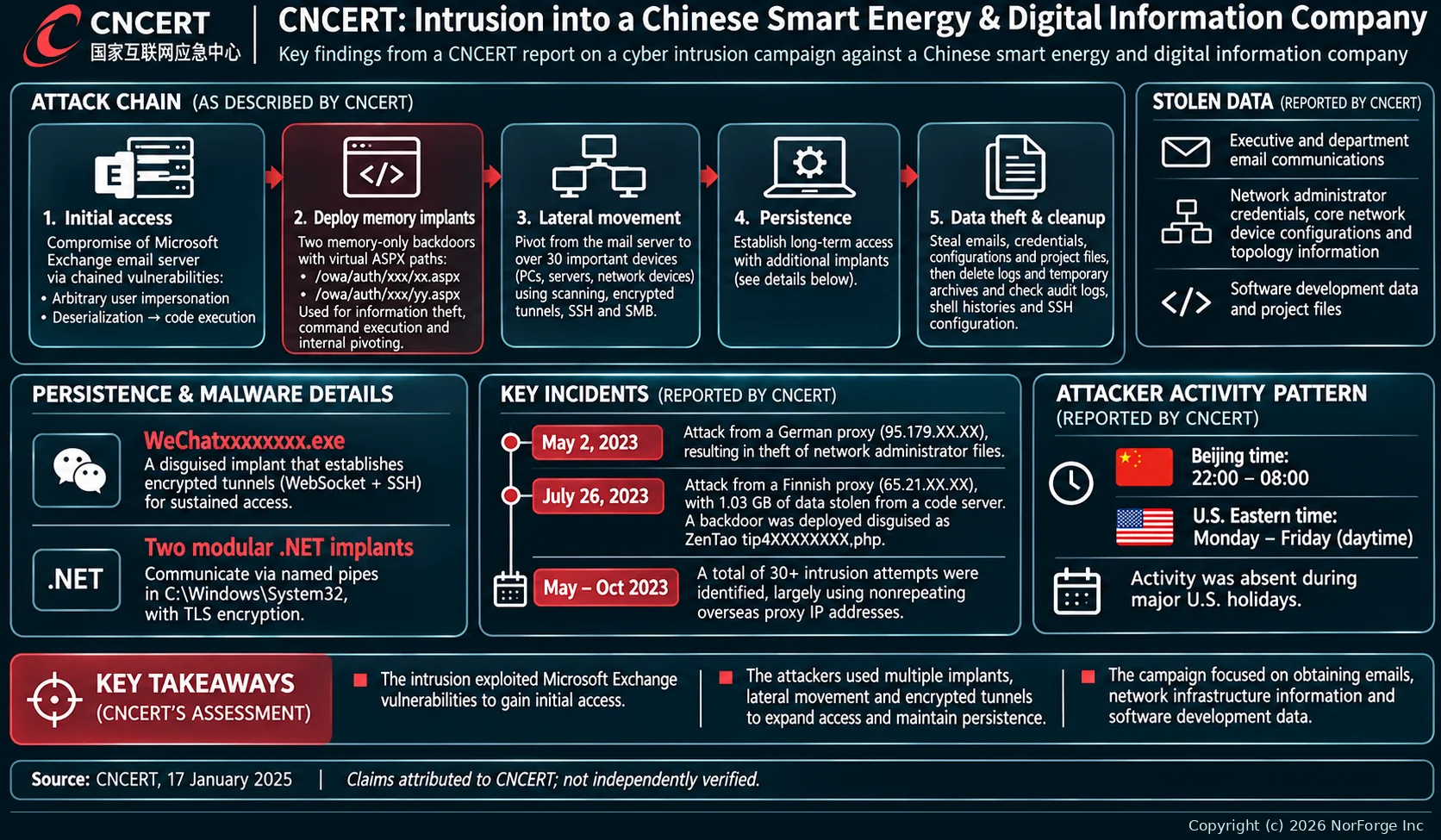
In the first case , attackers compromised a Chinese smart energy and digital information company by exploiting Microsoft Exchange vulnerabilities to inject memory-resident backdoors. They then infiltrated development servers, code repositories, network infrastructure, and administrators' workstations. Stolen data reportedly included emails, network configurations, credentials, source code, and project documentation. The CNCERT report mentioned that the attackers used rotating international proxy servers, log deletion, and anti-forensic techniques. Activity patterns were consistent with US working hours.
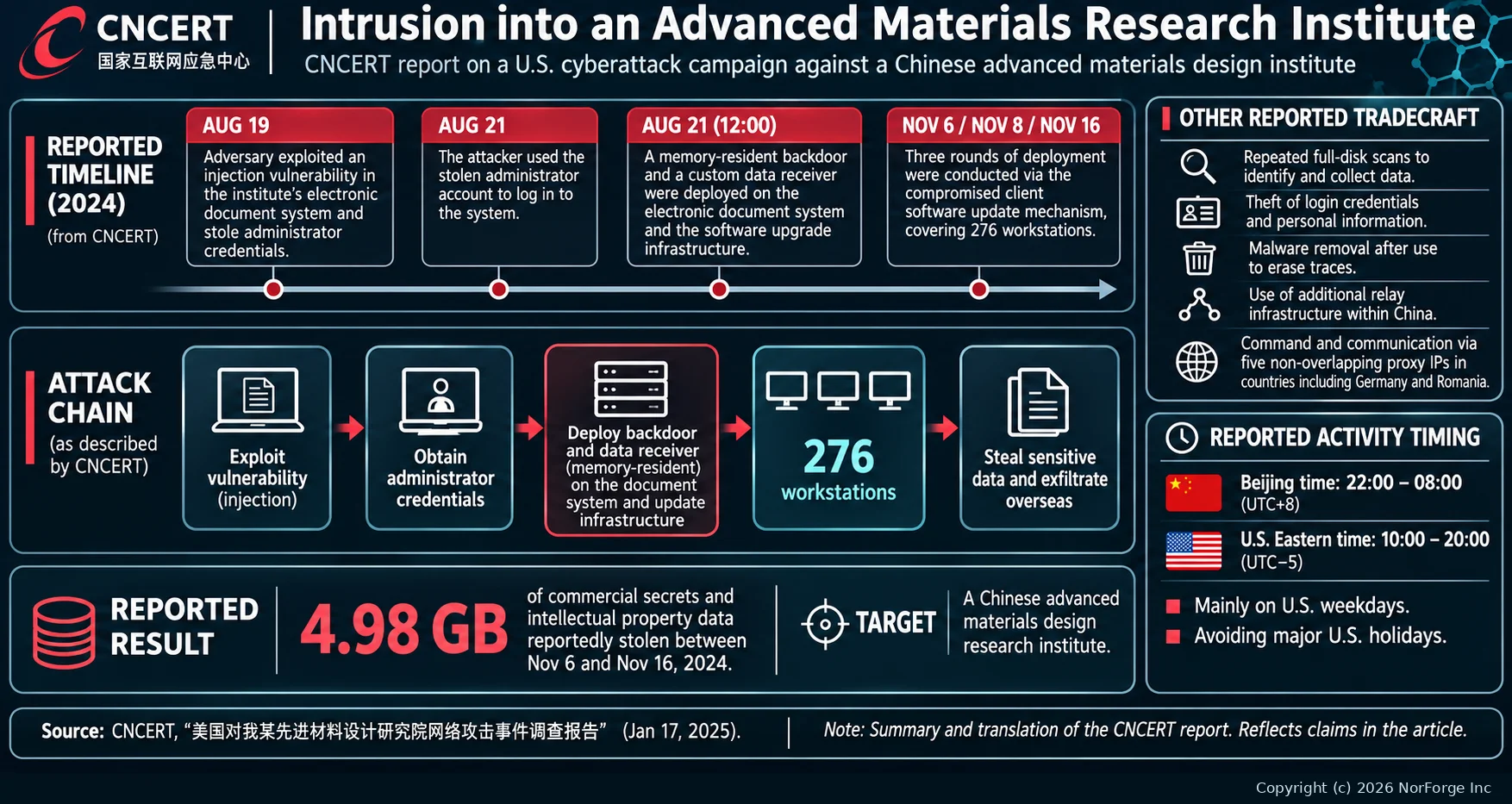
In the second case attackers compromised an "advanced materials design institute" by exploiting a vulnerability in its electronic document management system and stealing administrator credentials. The attackers then deployed memory-resident malware on the software upgrade server, and used its update mechanism to distribute more malware in three waves throughout November '24. The malware scanned local files, harvested credentials, and selectively exfiltrated documents matching keywords related to the institute's research, reportedly stealing 4.98 GB of sensitive business information and intellectual property. CNCERT stated that the attackers used proxy infrastructure in Germany and Romania, open-source tools, and fileless malware. Again, activity patterns aligned with US business hours and holidays.
That was about it. All IP addresses were redacted down to their /16's, file names and paths clobbered as well, no hashes included. In other words: Somewhat interesting, but nothing actionable, so the reports were quickly set aside for other matters.
The Clues
So the cases are thin on facts; but let us look at what is there.
The intrusion into a smart energy and digital information enterprise in 2023 only mentions redacted proxy ip's and the following file paths (x and y are redactions):
/owa/auth/xxx/xx.aspx
/owa/auth/xxx/yy.aspx.
WeChatxxxxxxxx.exe
tip4xxxxxxxx.php
Ufortunately, we drew a blank on these paths. They are either too common or too short to get good searches for. We stop here with this 2023 incident; CNCERT's analysis will be the last word for now.
For the rest of this article we'll focus on the second intrusion. That affected an advanced materials research institute in 2024, and contained these indicators:
/xxx/xxxx?flag=syn_user_policy
/xxx/xxxStats
And now we hit pay dirt.
The Speagle
In March 2026, the good folks over at Symantec and Carbon Black published an interesting article about a new malware they found. The malware in question, Speagle, was highly unusual in that it used functionality in a Chinese content management toolkit - Cobra DocGuard - to exfiltrate data. It was also peculiar because it appeared to look for keywords related to nuclear-capable missile technology.
When uploading stolen data it uses this url:
http://server_ip:port/CDGServer3/CDGClientDiagnostics?flag=syn_user_policyApart from one sample, Spagle is unique in using the syn_user_policy flag among files on VirusTotal. The odd sample out is a POC for a file upload exploit against exactly Cobra Docguard. This exploit apparently has no CVE, but it has an XVE: XVE-2023-25003.
Symantec attributed the malware to a threat actor they called RunningCrab, but stopped short of mentioning the involvement of any specific nation.
Could this be the malware used against the Chinese Materials Institute? Let's compare what we know of the cases.
CNCERT says this about the incident:
On August 19, 2024, attackers exploited an electronic file system injection
vulnerability to compromise the system and steal the administrator's account
and password information. On August 21, 2024, the attackers used the stolen
administrator account and password to log into the management backend of the
compromised system.
There is no public information as to what vulnerability was used to break in, but XVE-2023-25003 is a candidate.
The DocGuard platform had seen its share of problems before this. It had been abused in supply chain attacks multiple times from at least September 2021. Those attacks were attributed to assumed Chinese threat actors APT27/LuckyMouse and Carderbee and were mostly aimed at targets in Hong Kong. We don't know how those intrusions came about either.
Anyway, someone did get access to the DocGuard server of this target.
At 12:00 on August 21, 2024, attackers deployed a backdoor program and a
customized Trojan program to receive stolen data in the electronic file
system. To evade detection, these malicious programs existed only in memory
and were not stored on the hard drive.

The Trojan program was used to receive sensitive files stolen from the
compromised personal computers of the affected organization, accessing the path
/xxx/xxxx?flag=syn_user_policy.

The backdoor program was used to aggregate the stolen sensitive files and
transmit them overseas, accessing the path /xxx/xxxStats.
This would have been the server components, running in the memory of the compromised document server. We do not have copies of these.
On November 6, 8, and 16, 2024, attackers used a software upgrade function
on an electronic document server to implant a special Trojan program into 276
hosts within the organization. The Trojan program's main functions were: first,
to scan and steal sensitive files on the implanted hosts; and second, to steal
the victim's login credentials and other personal information.

The Trojan program was deleted immediately after use.
This would be the endpoint implants, designed to collect and upload data to the server.
These Trojans contained specific keywords highly relevant to the victim's work,
and upon finding files containing these keywords, they stole and transferred the
files overseas. The keywords used in these three theft operations were all different,
demonstrating that the attackers meticulously prepared for each attack and that the
attacks were highly targeted.
Functional comparison
Back to Speagle. How does it fit this picture?
Speagle has several modes that are controlled by a boolean setting in the configuration.
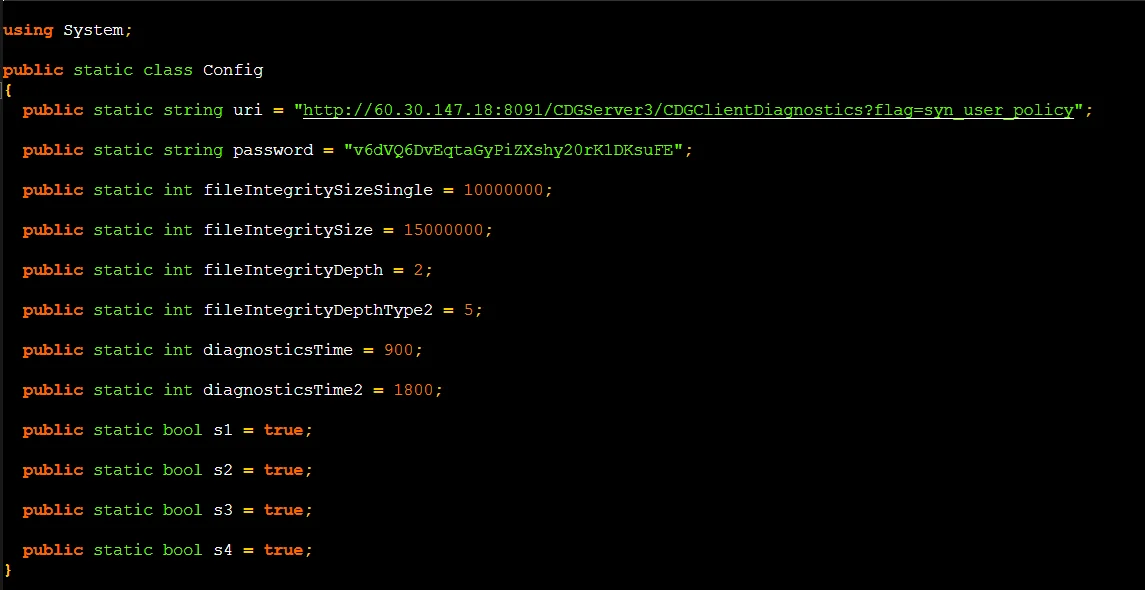
Initialize and identify victim
- Read DocGuard identifiers, username and hostname; modify a local configuration file.
- Send initial beacon
- Transmit an encrypted XML report identifying the host.
Stage 1 — System reconnaissance (s1, s2)
- Concurrent WMI enumeration and filesystem inventory, followed by a report.
Stage 2 — Browser data theft (s3)
- Collect browsing activity, autofill, cookies, credential databases and DPAPI material. Send reports.
Stage 3 — Targeted document theft (s4)
- Search accessible drives for filenames matching certain keywords, extract matching files, and transmit them to server.
Final cleanup
Attempt to make the running executable delete itself using DocGuard's own kernel driver API.
The Speagle code matches the CNCERT description. It steals files, it steals credentials, and it does self-delete.
Keyword list analysis
But there are other attributes to consider. For example, CNCERT says that the malware they encountered stole data "relevant to the victim's work" depending on keywords, and there were three versions or generations that used different keyword lists.
We have four verified Speagle samples; the same as Symantec lists in their blog. In addition, we have a number of samples that appear to be analysis artifacts created later.
The four samples have their compile date wiped, so we cannot say much about chronology from that. But the four configurations are all different in some way:
- V1. Simple config, server is 222.222.254[.]165
- V1. Simple config, server is 60.30.147[.]18
- V2. Gated config, server is 60.30.147[.]18, all stages on by default
- V3. Gated config, server is 60.30.147[.]18, only stage 4 on by default
From this it is clear that the main server at 60.* had seen three generations of malware. It is also obvious that there were two major revisions; one simple and likely early, where functionality is implicit and automatic, and a more refined and likely later one where functionality is gated through configuration options.
The simple V1 versions have no keyword search. There is actually no file exfiltration at all. These are pure recon tools for the two different targets. That makes it likely that the later versions V2 and V3 were launched as response to one of these initial recons, but we cannot be 100% certain of this.
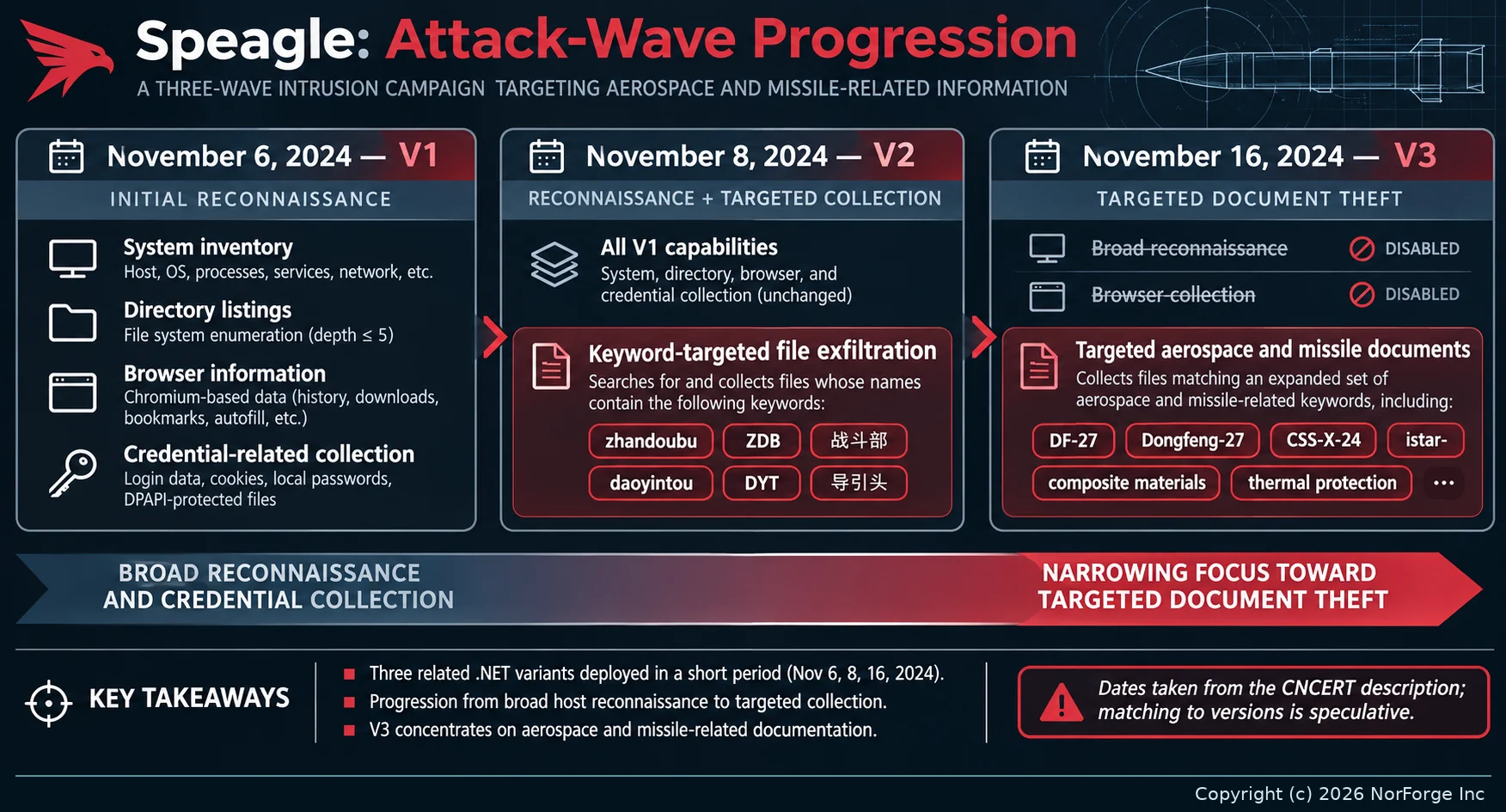
V2 had all stages on by default and did a search for these words:
| Keyword | English meaning / interpretation | Category |
|---|---|---|
zhandoubu | Pinyin for 战斗部 (warhead) | Missile components |
ZDB | Likely abbreviation of zhandoubu (战斗部) | Missile components |
战斗部 | Warhead / combat payload section | Missile components |
daoyintou | Pinyin for 导引头 (seeker head) | Guidance systems |
DYT | Likely abbreviation of daoyintou (导引头) | Guidance systems |
导引头 | Seeker head / missile guidance seeker | Guidance systems |
V3 had only stage 4 on by default. That means it ONLY searched for and exfiltrated files with names matching this wordlist:
| Keyword | English meaning / interpretation | Category |
|---|---|---|
Dongfeng-27 | Dongfeng-27 missile | Missile designation |
DF-27 | Dongfeng-27 missile | Missile designation |
CSS-X-24 | NATO/US reporting designation associated with DF-27 | Missile designation |
BZC1-5 | Unidentified technical designation | Technical identifier |
T800 | Likely T800 carbon fiber | Materials |
T700 | Likely T700 carbon fiber | Materials |
DCB | Unidentified abbreviation | Technical identifier |
DDT | Possibly Deflagration-to-Detonation Transition | Technical identifier |
weiyifangreceng | Thermal protection layer | Aerospace engineering |
weiyiguijia | Likely pinyin referring to a tail-section structure | Aerospace engineering |
istar- | Possibly Istar Space Technology Co Ltd, Tianjin | Technical identifier |
Istar- | Capitalization variant | Technical identifier |
ZYLF- | Unidentified technical designation | Technical identifier |
弹道导弹 | Ballistic missile | Missile technology |
巡航導彈 | Cruise missile (traditional characters) | Missile technology |
东风 | Dongfeng / East Wind | Missile family |
长剑 | Changjian / Long Sword (cruise missile family) | Missile family |
超音速 | Supersonic | Flight technology |
高超 | Hypersonic (abbreviated term) | Flight technology |
热保护系统 | Thermal protection system | Aerospace engineering |
尾鳍结构 | Tail-fin structure | Aerospace engineering |
弹头 | Warhead | Missile components |
航天 | Aerospace / spaceflight | Aerospace |
天线 | Antenna | Electronics |
喷嘴 | Nozzle | Propulsion |
陶瓷 | Ceramics | Materials |
复合结构 | Composite structure | Materials |
火箭 | Rocket | Propulsion |
复合 | Composite | Materials |
复合材 | Composite material (abbreviated) | Materials |
Speagle follows the description with one exception. According to CNCERT, the main target had seen at least three wordlist versions. Speagle does come in three versions, one without wordlists, two with. It is unclear whether this is a true difference or just a linguistic misunderstanding.
So who were these targeted IP's really?
This is not easy to know now. The first IP, 222.222.254[.]165, overlaps with a company making specialist gases. These are important in a whole host of different applications including military, and aspects of these are likely considered secrets. The second IP, 60.30.147[.]18, is part of a large chunk allocated to China Unicom in the Tianjin area. There are no recent domain resolutions to this IP or its close neighbors, and there are no banners or panels to give the game away. However, Tianjin is an important hub in Chinese military research and development and there are several candidate organizations this COULD have been - for example Tianjin University or China Aerospace Science and Industry Corp. There are also private companies in the mix, like AECC Aegis Advanced Protective Technology Co Ltd and Istar Space Technology Co Ltd. But we cannot make any conclusions as to the identity of the main target here.
Based on this, we assess with medium confidence that Speagle was involved in the "advanced materials" intrusion, even if there is no smoking gun to that effect. It is what we infer based on the CNCERT description. Whatever the case may be, Speagle is an interesting beast in itself, with clear military targeting and a Chinese/Tianjin geographical focus.
The Conclusion
So, were CNCERT/CC correct? Did a US-based threat actor hack Chinese companies?
The main arguments that CNCERT brings are the overall sophistication of attacks, as well as activity hours:
Analysis revealed that the attacks primarily occurred between 10 PM and 8 AM
Beijing time, which corresponds to 10 AM to 8 PM Eastern Time. The attacks
mainly took place from Monday to Friday in the United States, with no attacks
occurring on major US holidays.
This is weak sauce. Activity hours are at best supporting evidence; and for any advanced attacker this is trivial to adjust. However, it is possible that CNCERT has access to evidence that they did not disclose for various reasons, so their allegation can not be discounted out of hand.
Looking at Speagle as a malware family, if it indeed was used in the 2024 intrusion; it is not an advanced implant. The files are normal unobfuscated .NET assemblies (save for some simple string encoding). Apart from the use of DocGuard for exfiltration and cleanup, they are quite mundane infostealers within the capabilities of any backyard APT, and China has several regional rivals that have a history of spying on military matters.
Having said that, the OPSEC appears quite good. I think there is a real possibility that a fairly advanced adversary was involved but I don't see hallmarks of the real high-end intelligence machinery here, nor unequivocal fingerprints of a nation state. This was not stealthy, long-term infrastructure subversion, but an opportunistic sting. Not monitoring but harvesting.
But what about the Dongfeng-27 missile - the only weapon system referenced by name in the keyword list? Out of all the many weapons used by the PLA, why focus on that?
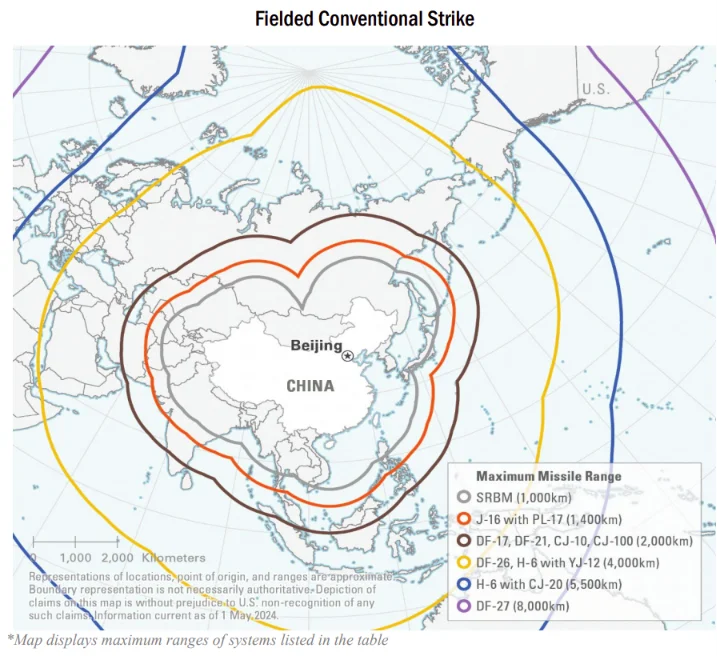
DF27 is described as an intermediate-range to conventional intercontinental ballistic missile (ICBM) and anti-ship ballistic missile (ASBM) with a hypersonic glide vehicle (HGV). It can reach speeds over Mach 8 (~9900 km/h) and has a range of up to 8000km - enough to reach Guam and Hawaii. A potent carrier killer, it sits at the apex of Chinese conventional missile capabilities. There are surely plenty of interested parties.
For IOC's please visit the original Symantec & Carbon Black blog post here.